Seminar Report on Role of Nanotechnology in Siddha Medicine for NCDsManagement.
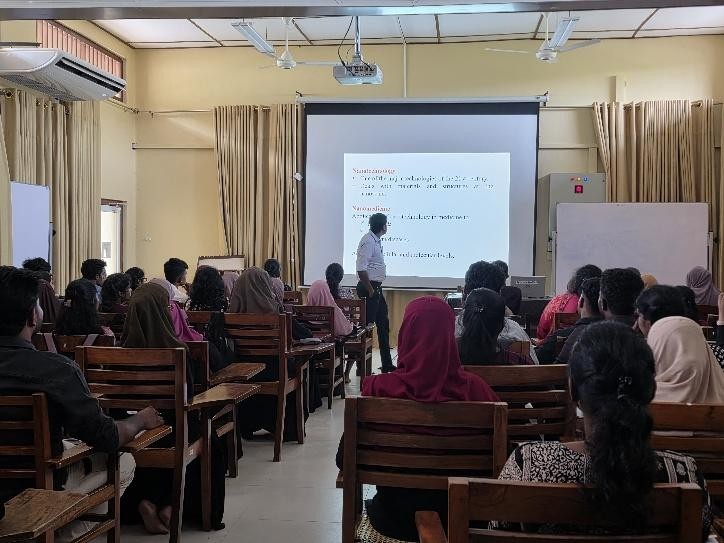
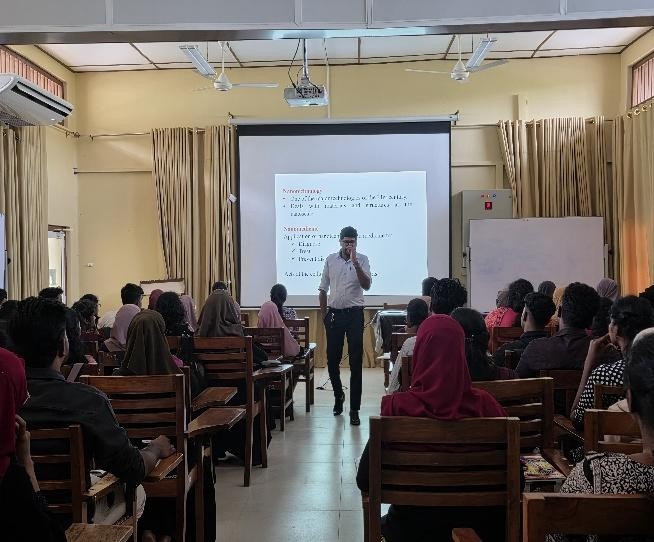
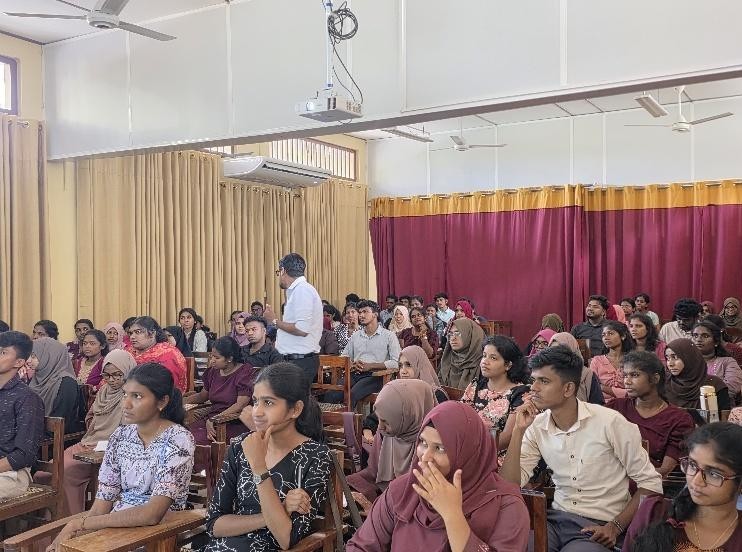
The department of Gunapaadam,The Faculty of Siddha Medicine, University of Jaffna, conducted a seminar on Role of Nanotechnology in Siddha Medicine for NCDs Management was conducted on 11 September 2026 from 2.30 p.m. to 4.30 p.m. at the Auditorium of the Faculty of Siddha Medicine. The programme was organized to enhance knowledge and understanding of the application of nanotechnology in Siddha medicine. The programme was
attended by Dr. (Mrs.) V. M. Prasad , head of deopartment of Gunapaadam , demonstrators, and phase 1 and 3rd yr students of the Faculty of Siddha Medicine. The presentation was delivered by Dr. T. SorubanMD(s) in Gunapadam,Senior Registrar trainee, PGIIM, University of Colombo, Sri Lanka who discussed the application of nanotechnology in Siddha medicine, particularly in the preparation, identification, and evaluation of Siddha medicinal formulations.The programme commenced at 2.30 p.m. with a welcome speech delivered by Dr. (Mrs.) V. M.Prasad, Following the welcome speech, the main presentation was delivered by Dr. T. Soruban.The presentation initially focused on what nanotechnology is and how nanotechnology techniques can be applied in Siddha medicine. Examples of Siddha medicinal preparations, such as Paṣpam and Chenduram, were discussed in relation to nanoparticles and their preparation.
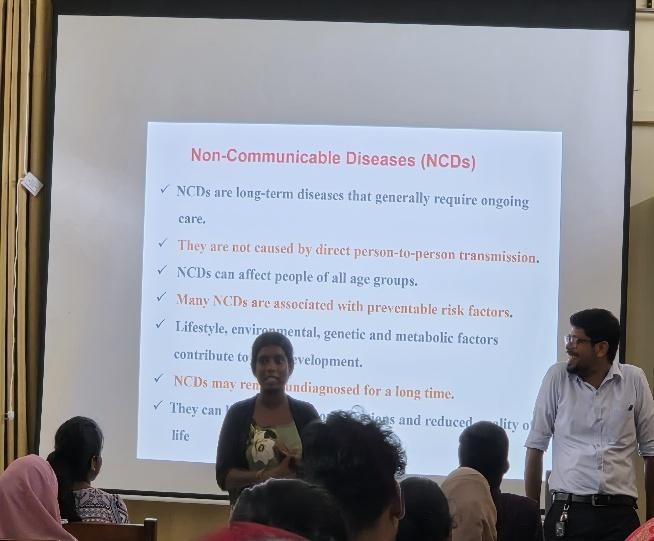
The speaker also explained the techniques used to identify and characterize nanoparticles in Siddha medicinal formulations. The potential advantages of applying nanotechnology in Siddha medicine were discussed, including increased bioavailability and improved efficacy of medicinal preparations. Another important topic discussed during the programme was non-communicable diseases (NCDs). The speaker explained the meaning of non-communicable diseases and described different types of NCDs. The differences between communicable diseases and non-communicable diseases were also explained.
Furthermore, the speaker discussed the possible application of nanotechnology in the management of non-communicable diseases. The concept of Tamil Maruthuvam (Tamiltraditional medicine) was also introduced during the session.A Siddha literary verse related to Aka Marundhu (internal medicines) was recited and explained.The medicines mentioned in the verse were discussed, and the speaker explained the relationship between traditional Siddha medicinal preparations and the reduction of particle size. The relevance of reduced particle size to the concept of nanotechnology was also emphasized. At the end of the presentation, two students were invited to present a summary of the programme.Following this, two students provided their feedback regarding the seminar. At the end of the presentation, two students were invited to present a summary of the programme. Following this, two students shared their feedback on the seminar.
Student 1:
The seminar on “Role of Nanotechnology in Siddha Medicine for NCD Management” was highly informative and helped enhance our knowledge. It provided valuable insights into the potential integration of nanotechnology and Siddha medicine in the management of NCDs.
Student 2:
The seminar introduced new information about nano-sized particles, Siddha formulations, and their therapeutic applications, along with supporting scientific evidence. The concepts of reduced particle size, increased surface area, absorption, and bioavailability were also explained in relation to Siddha medicines. Overall, the seminar highlighted the importance of integrating traditional Siddha knowledge with modern scientific technologies for further research and
development.
Finally, Mr.M.N.M Fousath, a student, and Mr. N.Arivalakan, a demonstrator, delivered the vote of thanks to the resource person and the organizers.
The programme concluded successfully at 4.30 p.m. The seminar provided valuable knowledge about the relationship between nanotechnology and Siddha medicine, particularly regarding nanoparticle size, characterization techniques, bioavailability, efficacy, and the potential application of nanotechnology in the management of non-communicable diseases. The session also helped the participants understand how traditional Siddha concepts can be explored and
evaluated using modern scientific approaches.